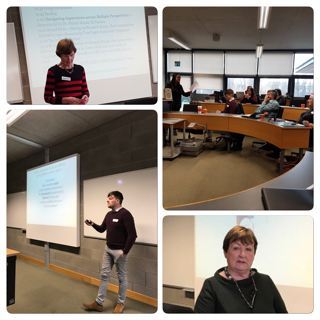
NEARImeet (Network for Educational Action Research in Ireland) in St. Patrick’s College, Thurles on 12 Sept 2015

The third NEARImeet (Network for Educational Action Research in Ireland) took place in  St. Patrick’s College, Thurles on 12 Sept 2015.

Guest speakers were Dr. Pip Ferguson (DCU) and Dr Máire Ni Ríordáin (NUIG) with Round Robin presentations by John Cullinane and Tom Cosgrove.

IMG_1315

Pip Ferguson, John Cullinane, Máire Ní Ríordáin and Tom Cosgrove


Dr Pip Bruce Ferguson spoke around the topic: ‘How to strengthen the rigour of action research: reflections ‘from the field’.  Pip spoke about the need to judge our research with appropriate criteria. She outlined the LET approach – Whitehead’s living educational theory (1989) – which emphasises values and accountability and spoke about the need to leave a ‘snail trail’ – a clear path or track through the research that can be followed by the reader.

John Cullinane spoke about his experiences using self-study action research in St Patrick’s College as an undergraduate and how this experience has now transformed his practice as a qualified teacher. John researched his own practice around issues of equity.  His research has led to the promotion of  inclusive practices in his institution.

Tom Cosgrove presented a fascinating account of his efforts to promote active learning methodologies in relation to the teaching of engineering in a Chinese context. This was a richly illustrated account of teaching and learning in a difficult linguistic and cultural setting. Tom’s presentation showed how, like John he was living his educational values in his practice.

Dr Máire Ni Ríordáin spoke on the topic of ‘Making sense of your data’. Máire emphasised trustworthiness and the need for multiple perspectives and asked the question ‘How can a reader trust my account? Criteria used included:  Evidence of Becoming/Improving Self-Reflexivity Multiple Perspectives , Connection , Meaningful Action Acknowledgement of Limitations Ethical and Professional use of Data.

There followed a Skype conversation with Jack Whitehead (UK) and Delysia Norelle Timm (SA) on the value of networking and sharing ideas.

skype with Jack and Delysia


Mary Roche, Caitirona McDonagh, Pip Ferguson, Máirín Glenn, Bernie Sullivan and Jane O’Conell via Skype from Jack Whitehead and Delysia Norelle Timm.


Hegemony in the library

Recently I have been reflecting on Schön’s ideas around ‘reflection-on-practice’ (1983) and trying to come to grips with what it means to ‘critically reflect’. In general, I am enjoying the process as I read my books and discuss the ideas with my friends and colleagues both here at EARI and NEARI and with others besides.

However, I do feel a certain sense of frustration, when it comes to accessing good, up-to-date literature on critical reflection. As an ordinary, practising teacher I have limited access to any academic libraries and therefore, sourcing literature is a problem. As a paid-up member of the Teaching Council of Ireland (the professional standards body for teaching that promotes and regulates the profession), I am entitled to limited access to EBSCO, for which I am hugely grateful. But, access is limited. It is very frustrating when I search for a paper on a particular topic, and find that while it may be listed on ‘our’ version of EBSCO, it is not available to view or download for us ordinary teacher, especially those who wish to adhere to copyright legislation.

I decided I would try to do something about my dilemma: I would become a member of an academic library and pay whatever fees were required to gain access to a library and online journals.

Readers, you can imagine my delight when I discovered that I could become an alumni member of my old alma mater; visit the library; read the books and even, believe it or not, access online journals! However, my joy quickly evaporated as I came to learn that I could not borrow any books; could not access the online journals from home; could not bring my laptop into the library to access online journals nor even print any sections from journals accessed from within the building!

As I returned discontentedly (and crankily) to my own pile of bought books and slightly out of date academic papers, Chomsky’s words around an education system that keeps ‘people from asking questions that matter’, (Chomsky 2000, p.24) came to mind. I wondered how I could reflect on my practice; question any underpinning assumptions regarding my practice; and become a critical thinker, unless I had adequate access to the literature. I speculated about how educators are expected to keep abreast of current thinking in education, unless they can access current journals. I wondered if my exclusion from online libraries was more than just a major inconvenience, or was something more sinister afoot.

Freire (2003) believed that issues of power, oppression and culture existed in many aspects of education, and he sought to unravel their existence and I began to think that, perhaps, I too am a victim of power and oppression in a culture that presumes that educators do not need to read. The word ‘hegemony’ floated into my thoughts. Gramsci (1971) has been instrumental in developing our understanding of ‘hegemony’ and Brookfield described it as: ‘The assumptions we accept unquestioningly as commonsense are sometimes the same ones that have been constructed by a dominant group or class to keep us servile and marginalised’ (2009: 295). Brookfield suggests that for reflection on practice to be critical, it needs to call power relations and hegemonic dimensions into question.

So I began to ask myself some questions (that matter) as I reflected critically:

I wonder why we think it is acceptable for educators to have limited access to the literature on education?

I wonder who makes up the rules for academic libraries?

Who really thinks it is good for us to be excluded from academic libraries?

Who are the powers-that-be that benefit from a teaching population that is not allowed access to current thinking in education?

Why is this situation acceptable to (nearly) everyone?


Brookfield, S. (2009) ‘The concept of critical reflection: promises and contradictions’, European Journal of Social Work, 12:3, 293-304

Chomsky, N. (2000) Chomsky on Miseduation, Oxford: Rowman and Littlefield

Freire, P. (2003) ‘From Pedagogy of the Oppressed’ in A. Darder, M. Baltodani and R.D. Torres, (eds), The Critical Pedagogy Reader, London: RoutledgeFalmer, 57- 68

Gramsci, A. (1971) Selections from the prison notebooks. Ed. Q. Hoare and G.N. Smith. London: Lawrence and Wishart.

Schön, D. (1983) The reflective practitioner: How professionals think in action. New York: Basic Books.

Second meeting of the Network of Educational Action Research in Ireland (NEARI)

The second meeting of the Network of Educational Action Research in Ireland will take place in NCI, Dublin on Saturday, 13 June 2015.

This is part of our initiative to establish a collegiate group of people who have an interest in action research; reflective practice; living theory; critical thinking and examining one’s values. We aim to establish a network of educators who wish to share their insights with others and to listen to the narratives of others, in a journey towards educationally productive dialogue.

On foot of the hugely successful Action Research Network of the Americas (ARNA) Conference 2015, we feel that there is now a growing wave of global interest, passion and excitement around action research and its underpinning principles. We wish to embrace that passion and use it to energise our new network.

Our network is based on people and their interests in action research, solely. We have no affiliation to any political groups, universities or other institutions. Please feel free to contact us at info@eari.ie if you would like to join our network.

Establishing a new network

Yesterday, the inaugural meeting of the Network for Educational Action Research in Ireland took place in a flurry of excitement, trepidation and heart-felt delight. It was a pleasure to be in the company of so many people who were of, or had an interest in being of, an ‘action-resercherly’ disposition. Stories of the magic of and, indeed, the pitfalls of self-study action research were shared as victory narratives were cast aside, and an amazing sharing of theory and stories of learning took place.

I am already looking forward to our next meeting…

double pic

Education Symposium and Book Launch in St. Patrick’s College, Thurles

Screen Shot 2015-04-07 at 20.00.54

Watch the education students in St Patrick’s College, Thurles speak with passion on Irish TV about how they use self-study action research to help them enhance their practice at the college’s first Education Symposium (at about 18 minutes into the clip).
Listen to Dr. Mary Roche speak at the launch of her new book in the college. Mary is on the shortlist for the prestigious UKLA Academic Book Award 2015 for her beautiful new book Developing Children’s Critical Thinking through Picturebooks: A guide for primary and early years students and teachers, which is published by Routledge.  UKLA say: ‘The voices of children and teachers, richly engaged with picturebooks, resound enthrallingly from this enthusiastic, thoughtful and superbly well-informed account of productive classroom practice.’

Students speaking about action research and book launch in St. Patrick’s College, Thurle


Why have an Action Research network? Thoughts from New Zealand by Pip Ferguson

I have recently (April, 2014) moved to Ireland from New Zealand, and have been feeling ‘cut off’ from a functioning action research community since my arrival. This is understandable, as I had worked in a staff development context in New Zealand for over thirty years (I am in a similar role here, in Dublin City University). In that role, I had studied action research, done a PhD using action research to help develop a research culture in the institution where I then worked (a polytechnic), and participated in the formation and ongoing work of the New Zealand Action Research Network (NZARN). So it is from that background that I want to reflect on the benefits of such a network, and to raise possibilities of joining or establishing such a network here in Ireland.

The NZARN was the brainchild of Eileen Piggot-Irvine, and its inception in 1992 was supported by Judith McMorland and myself. Eileen and I were doing staff development in polytechnics; Judith was a lecturer in a university. There was no existing action research organisation. We felt that many of those who were likely to be interested didn’t know each other well and some were in institutions in which support for such a venture was likely to be novel and not necessarily well supported (possibly because of the approach not being well known and flying in the face of more established traditions of research). So we decided to offer a network, rather than a formalised, centralised ‘committee’. We kept the subscriptions to $10 per annum, money that was used to print and post newsletters as this was in the days before widespread computerised access and apps. These days, of course, the latter would be used and the subscriptions would not necessarily be needed.

The newsletters provided space for people to write short accounts of work they were doing, using action research in a variety of contexts – social work, policing, agriculture as well as the more usual educational contexts. We included snippets of action research events and developments from around the world, as we became aware of these. New Zealand is a long way from the rest of the world, and people can feel cut off. So the newsletters sought to keep us up to date with action researchers at home and overseas. All work done by the Network was voluntary, but huge energy and commitment was put in by Eileen, whose passion for AR was well known and widely appreciated. The compiling of the newsletters was mainly done by her.

We didn’t have cash reserves to pay for speakers or travel. NZARN aimed to appeal to a broad spectrum of practitioners, although teachers and lecturers were the most prevalent. Increasing costs meant we had to increase the subs to $30 in 2003, and this proved a disincentive to some from continuing.

However, key to the ongoing success of the Network were the annual conferences. There was a registration cost for these, and it helped to fund travel costs and accommodation for keynote speakers. The Newsletters provided continuing connections and information, but the opportunity to meet face to face, and to hear directly from inspiring keynote speakers and each other, was vital. It was very helpful that many of us worked in institutions where at least administrative support and copying costs might be met, if not a contribution to the costs of visiting speakers and the free provision of facilities, which happened in a few cases.

The value of action research networking across countries was demonstrated, in that we were warmly and generously supported with keynote speakers from the then-named Action Learning, Action Research and Process Management group, Australia-based. Eileen and I were both represented on their Committee over a number of years; hence we had quite strong connections with that group. Over the years, we had Profs Robin McTaggart, Yoland Wadsworth and Ortrun Zuber-Skerritt donate their time as keynotes, with just accommodation and travel covered by NZARN. Other keynotes were provided by New Zealand action researchers over the years that the Network was active (its activity declined in 2004, after the Christchurch conference). Over the time that NZARN operated, we did our best to shift the conferences around a long, narrow country. The bulk of our membership was in the North Island, so most conferences were held there, but there were a couple held in the South Island.

There is now a New Zealand Collaborative Action Network operating, affiliated with the CARN group in the U.K. Again, it is supported by colleagues from Australia, with Prof Susan Groundwater-Smith visiting the University of Waikato where I was located last, in 2012 and subsequently. New Zealand’s close action research relationship with Australia continues.

Having come to Ireland, I have been searching for action research connections, and am delighted to have been ‘introduced’ to EARI colleagues by Prof Jack Whitehead, with whom I have worked for a good number of years. We have so far ‘met’ via Skype, and have a face to face meeting scheduled in Dublin in the next two weeks. We are hoping in that meeting to investigate networking of action researchers across sectors and across Ireland. Watch this space!

Dr Pip Ferguson

Teaching and Learning Developer
Teaching Enhancement Unit
Dublin City University


Mary Roche makes the UKLA 2015 Award shortlist!

We are delighted to share the news that our colleague, Mary Roche, is on the shortlist for the prestigious UKLA Academic Book Award 2015 for her beautiful new book Developing Children’s Critical Thinking through Picturebooks: A guide for primary and early years students and teachers, which is published by Routledge.  UKLA say: ‘The voices of children and teachers, richly engaged with picturebooks, resound enthrallingly from this enthusiastic, thoughtful and superbly well-informed account of productive classroom practice.’

The award is presented for recently published academic text about the teaching of English for teachers, students, consultants or HE tutors. The panel looks for books that make a lasting, significant contribution to the teaching of English.

We at EARI are delighted with the news and we wish Mary the best of luck with the award!

Catching the moon in 2014

I’ve been thinking about the amazing capacity children have to ask questions…and comparing it to the fairly weak ability to question that we, as adults, have. Young children continuously ask ‘Why?’ They ask questions like: ‘Why is the sky blue?’ ‘ How does the moon stay in the sky?’ ‘Why are you cutting the grass?’…and so on. Questioning helps children develop a better understanding of their world. Questioning also helps adults develop a better understanding of their world.

But at some stage along the way, lots of people lose this interest in asking questions. They accept things as they are. The moon stays in the sky and while they may not understand exactly why or how it stays there, it is of little interest to them, unless, of course, it becomes unstuck and begins to roll down at them!

It’s a pity that many of us adults lose that ability to question and to seek the moon. It’s even sadder for those of us who are educators to lose that ability, because, often, our ability to question, can help light the pathways of learning and thinking for the students in our care.

Vicki Davis in her Cool Cat Teacher Blog at http://www.coolcatteacher.com asks that 2014 should be the year of questioning. She says:
Let 2014 be the year we question. We must question why we do things certain ways. Why are desks in a row? Why do we use desks shaped that way? Why do we arrange classrooms a certain way? Why do we do certain things at certain times? Why?
For in asking questions we can uncover our intentions. Are we doing things a certain way because those patterns were put in place decades a go for some reason? Or are we doing those things because we decided that is the right thing to do for our students?

(Read the entire blog at www.coolcattetacher.com)

Let us begin our year by enlightening ourselves and enriching the lives of those we teach by relearning that ability to ask a question…and catch the moon maybe.