Teachers taking control: a new vision for professional development

“challenge on and for individual teachers to take more personal responsibility as professionals, for undertaking the professional development they require.”

Click on http://bit.ly/1e38hch

Here at www.eari we recommend a self-study action research approach to teacher CPD – it provides teachers with autonomy over the methodology, the research focus and the improvement in practice and understanding of practice.

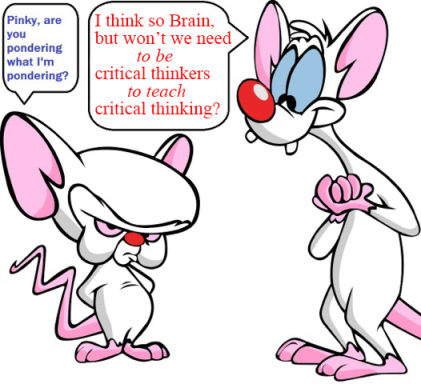
To teach critical thinking

critical-thinking

Fromm (1979) worried that people had lost the ability to think for themselves and had become used to collective ‘herd’ thinking. He argued that people must exercise their freedom in thinking for themselves – with the main kind of freedom being a ‘freedom of being’ which involved the courage ‘to let go [of deeply entrenched habits of non-thinking] and respond’ (p.24).

What relevance might this have for self-study action research in particular or for critical and reflective practice in general? What relevance does it have for CPD for teachers? Can ‘top-down’ or commercial packages of CPD be effective? I argue that teachers must ‘buy into’ CPD for themselves, choose their own areas for improvement and begin the process of actively seeking to live their examined and articulated educational values in practice. This takes BEING a critical thinker and thinking for oneself.

Self-study Colloquium at Hope University Liverpool

Hope University Liverpool is the location for an exciting colloquium entitled ‘Researching our own Practice: transforming the world through transforming ourselves’ (see http://www.researching-own-practice.com)

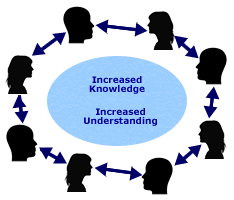
Máirín and Mary will participate in the Colloquium which runs from 25th -27th July 2013. The colloquium seeks to bring together researchers of own practice who will share research experience and showcase their success stories. They hope to learn with and from each other. The Colloquium provides an opportunity to engage in meaningful discussion about what needs to happen to enable such inquiries to be accepted as having different but comparable value to more traditional third person forms of research.

Draft papers for the colloquium including Máirín’s and Mary’s may be accessed at: http://www.researching-own-practice.com/index.php/papers

Online Summer Course 2013

Enhancing Practice through Reflection, Action and Self-Evaluation
Summer Course 2013 Online (Primary teachers are entitled to three EPV days)

Click here to apply through Mayo Education Centre

In this course, you will:

  • explore ideas such as reflective practice and critical thinking,
  • make a personal action plan to enhance and evaluate your everyday work
  • see and hear the experiences of Irish teachers and some international experts who have spent years conducting self-study of their teaching
  • examine the current guidelines on self-evaluation from Department of Education and Skills that encourage teachers to become more active in a process of improving their own work practices.

Course leaders: Drs. Máirín Glenn, Caitriona McDonagh, Mary Roche and Bernie Sullivan
More information at http://www.mayoeducationcentre.ie

To book your place on this course go to http://www.mayoeducationcentre.ie

Forthcoming – International Research Methods Summer School

IRMSS Conference Schedule

This conference may be of interest to anyone engaged in education research. The programme includes a symposium by a group from St Pats Thurles which may be of particular interest to students in ITE.

In Year 3 the student teachers in St Pats Thurles identified an area of concern to them, arising from their year 2 and 3 School Placements. They then undertook a review of the literatures surrounding the conceptual frameworks of their area of study so as to deepen their understanding of their area of concern. In Year 4, in order to try and improve their teaching in relation to this area of concern, they carried out a small scale self study action research project during their final school placement. The research was conducted in collaboration with several critical friends – including pupils, cooperating teachers, tutors and peers.

Three of the student teachers will present their work at the IRMSS accompanied by Dr Mary Roche and Dr Jennifer Johnston from the St Pats Thurles Education Department.

Self-Evaluation

Self-evaluation is currently being promoted in Irish school settings, both primary and secondary, by the Department of Education and Science (DES) (2012). The rationale behind this initiative appears to be that schools can achieve an improvement in the standardised test results of their pupils in literacy and numeracy through the use of self-evaluation. In other words, the self-evaluation process as proposed by the DES is another form of accountability to be undertaken by teachers. However, the concept of evaluation that has been outlined by the DES could be classified as whole-school evaluation, rather than self- evaluation by individual teachers. I do not think that whole-school evaluation has the potential to achieve the desired improvement.

Improvement constitutes a change, whether the change is in approach, in thinking or in attitude. Often we cannot easily bring about changes in others or in situations, and so we need to begin the process of change with ourselves. The desire to change our practice may stem from our experience of feelings of unease or of dissatisfaction with the status quo. We may wish to change the way we have always done something, in order to find a more effective way of doing it. This process necessitates engaging in self-reflection. Teachers who wish to reflect on their practice could ask themselves questions such as, ‘What did I do?’ and ‘Why did I do it?’ To answer the ‘why’ questions, teachers could refer to their educational values.

It is not always easy to articulate our values, but if we ask ourselves questions, such as ‘What do I value in the area of education?’ or ‘What is important to me in my role as educator?’, it will be easy to come up with three or four things that really matter to us as teachers. The next step is to reflect on these values and to determine if we are living out these values fully in our teaching lives. For example, I may have come to the realisation that I value a democratic, participatory approach in my teaching but, when I reflect on what is actually happening in my classroom, I may find that I am using a didactic style of teaching that does not allow for full pupil participation.

I would suggest, therefore, that the DES should promote self-evaluation by individual teachers at classroom level as a first step towards improvement. Then, when teachers have made some progress in reflecting on their practice and in trying to live to their values, a process of whole-school evaluation could begin. Improvement is more likely to occur when teachers are using a values-based approach to their classroom practice.